The Quiet Luxury of Already Owning It
Let me confess something first: I used to think sustainability was a shopping decision. Buy the hemp version. Buy the organic one. Buy better. Buy, buy, buy.
Then I counted my t-shirts. Forty-one. I wear maybe six. And somewhere in the back of my closet, a linen shirt I bought in 2019 — the one I paid 'too much' for — has outlasted three seasons of trend purchases and looks better now than the day it arrived.
That shirt taught me the math that haul culture doesn't want you to do.
The Real Price Tag
Every garment has two prices: what you pay at checkout, and what it costs per wear. A $12 tee worn twice costs you $6 per wear. A $90 jacket worn 300 times costs 30 cents. The 'expensive' item was the cheap one all along.
This is the 30-wear test, popularized by Livia Firtel's question — will I wear this 30 times? — and it's the single most radical question you can ask before checkout. Not because 30 is magic, but because it forces you to imagine your actual life with this object. Be honest: will you reach for that sequin top on a random Tuesday in Columbus, or is it a one-night stand with your own wardrobe?
The environmental math follows the personal math. Every additional wear cuts a garment's footprint per use. The most sustainable garment isn't the one made from the most virtuous fiber — it's the one you already own, worn until the seams give up.
Building a Capsule That Actually Fits Your Life
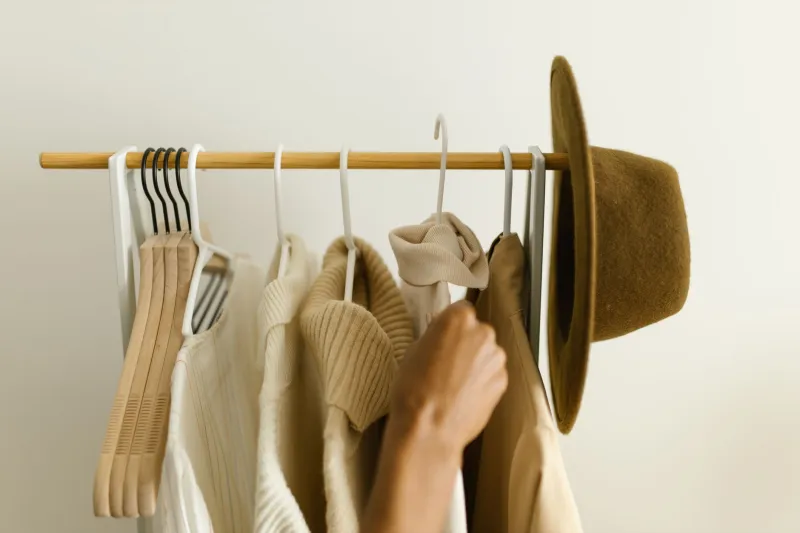
A capsule wardrobe has a reputation for being minimal, beige, and vaguely Scandinavian. Ours is simpler: a small rotation of durable, natural-fiber pieces you genuinely like. No uniform required.
Start with the workhorses:
- One hemp or hemp-blend tee. Hemp gets softer with every wash, needs less water than conventional cotton, and shrugs off wear like nothing else. It's the fiber we built this whole site around for a reason.
- One linen shirt. Wrinkles are a feature. It breathes through a humid DC August and layers under sweaters come November.
- Denim you'd rescue from a fire. Raw or not, buy once, wear for a decade.
- One heavyweight knit. Wool or cotton, something that survives the dryer of life.
- Bottoms in a neutral that matches all of the above.
Notice the theme: natural fibers, sturdy weaves, colors that play well together. When everything mixes, you need less — and what you own gets worn evenly instead of rotated through favorites and orphans.
What Slowing Down Actually Feels Like
Here's what nobody warns you about: buying less changes how you see your clothes.
When you stop treating your closet as an inventory to be refreshed, it becomes something closer to a relationship. You learn which collar sits right. You notice the exact moment a hem needs attention, and you fix it — maybe even yourself, with the world's most crooked stitch, which somehow makes you like the shirt more.
There's a quiet confidence in repeat outfits, too. The people you admire most probably wear the same ten things on rotation. Steve Jobs had his turtleneck; your favorite professor has had the same corduroy jacket since the Clinton administration. Nobody remembers what they wore. They remember how they showed up.
And the haul videos? Watch one with new eyes. That dopamine spike is real, but it's a rental — the joy of the package, not the garment. The joy of a well-worn hemp tee on its 200th wash is slower, but it's yours.
A Challenge, Not a Rule
We're not asking you to quit shopping. We're a clothing brand; that would be strange. We're asking you to shop like someone who plans to keep things.
Try this: for the next month, buy nothing new. Wear what you have, repair what's worth repairing, and keep a note on your phone of what you genuinely wish you owned. At the end of the month, you'll have a list of maybe two or three things worth buying well — instead of forty things bought cheaply.
The most radical thing in your closet this year might be the oldest thing in it. Wear it again. Wear it out. That's the story worth telling.