Pass the Gravy, Not the Guilt Trip: Surviving Holiday Talk About Your 'Expensive' Clothes
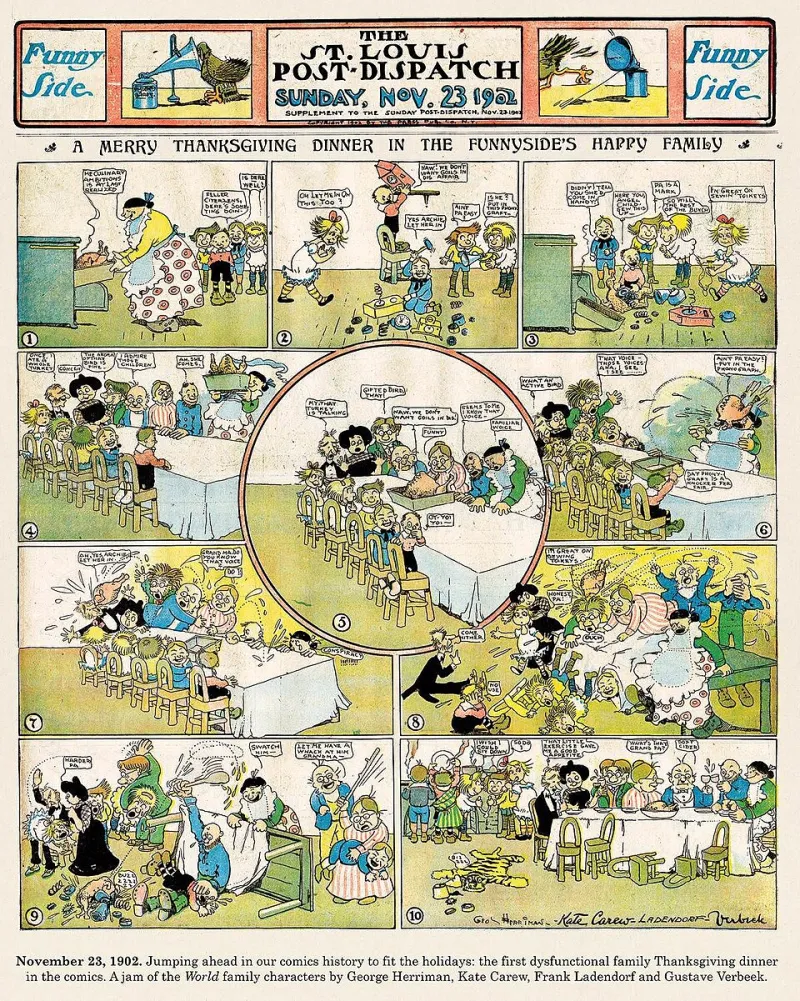
Photo: George Herriman (1880-1944), Kate Carew (1869-1961), Frank H. Ladendorf (1860-1943). Gustave Verbeek (1867-1937), Public domain, via Wikimedia Commons
Somewhere between the cranberry sauce and the pumpkin pie, it will happen. Someone — probably a well-meaning aunt or a cousin who just discovered golf polos in bulk — will squint at your sweater and say the words every conscious dresser dreads: *"Wait, you paid HOW much for that?"
Welcome to the Thanksgiving Table Test. And unlike the turkey, you can't just fake your way through it.
First, Breathe: They're Not Attacking You (Mostly)
Here's the thing about relatives: most of them aren't critiquing your values. They're running outdated software. For decades, the price tag was the only metric anyone had. A $12 shirt was "a deal" and a $120 coat was "a splurge," full stop. Nobody talked about groundwater in manufacturing towns or the garment workers earning less per hour than the turkey cost per pound.
So when your uncle balks at your hemp-blend overshirt, he's not really arguing with you. He's arguing with a shopping culture he barely knows has changed. That reframe alone takes about 80% of the sting out of the moment.
The Math That Actually Lands: Cost Per Wear
Skip the guilt. Skip the glacier facts. Lead with money, because money is the family love language at every holiday table from Ohio to Oregon.
Try this: "This shirt cost $90, but I've worn it 60 times this year. That's a buck fifty a wear. Your $15 tee that pilled after four washes? That's almost $4 a wear — and it's already in the rag bin."
Cost-per-wear is the single most persuasive tool in the conscious closet arsenal because it doesn't require anyone to care about supply chains. It just requires them to care about their wallet. And nothing gets a skeptical relative leaning in faster than the suggestion they might be overpaying.
Have the Receipts — Literally
If you really want to win the table, bring specifics. Not a slideshow, please, we're begging you. Just one or two concrete facts delivered casually, like you're mentioning the weather:
- The average American tosses roughly 80 pounds of clothing a year, and most of it doesn't get recycled — it gets landfilled or shipped overseas.
- Fast fashion's "cheap" prices are cheap because someone else is absorbing the cost, usually a garment worker or a river.
- Clothes made from stem fibers like hemp and flax often need a fraction of the water and pesticides that conventional cotton demands.
Drop one. Let it sit. Don't stack three facts into a lecture — that's how you end up eating stuffing alone in the kitchen.
The Deflection Toolkit: When You Just Want to Eat in Peace
Let's be honest. Some years, you don't have the bandwidth. The goal is pie, not proselytizing. Keep these in your back pocket:
The Pivot: "You know what? I'll send you a link, it's easier than me explaining it." Then change the subject to literally anything: the game, the gravy recipe, whether anyone is actually going to see the new pumpkin movie.
The Compliment Flip: "I appreciate you noticing it — that's the whole point, I want to wear it for years." It's warm, it's true, and it ends the line of questioning without conflict.
The Humor Defuse: "It's cheaper than therapy and it lasts longer than my New Year's resolutions." Self-deprecation is the Swiss Army knife of family dinner. Deploy liberally.
The Genuine Invitation: If someone's actually curious — and sometimes the youngest cousin is, more than you'd expect — offer to take them thrifting or show them your favorite brands after the holidays. Curiosity shared over leftovers beats a debate served with dinner.
What NOT to Do at the Table
A few friendly guardrails from those of us who have learned the hard way:
- Don't critique anyone's outfit. You're wearing sustainable clothes, not a badge of moral superiority. The moment you side-eye someone's polyester, you've lost the room.
- Don't quote statistics like scripture. Two good facts beat twelve fuzzy ones.
- Don't expect conversion. Your job isn't to change anyone's closet in one meal. It's to plant a seed and then pass the rolls.
The Long Game
Here's the quiet truth: holiday conversations about conscious clothing rarely change minds that day. But six months later, when your cousin is standing in a mall feeling vaguely queasy about a $8 tank top, a little voice might whisper cost per wear. That voice? That was you, somewhere between the yams and the dessert.
Living your values visibly — wearing clothes with stories, mending instead of replacing, shopping less and loving it more — is the argument. The words are just the garnish.
So this Thanksgiving, dress in something you're proud of, keep your answers short and warm, and remember: the best rebuttal to "that's too expensive" is a wardrobe that's still going strong at next year's table.
Now pass the gravy. You've earned it.