The 12-Cent Button That Ends Your Shirt’s Second Life
A hemp-cotton shirt lands at a recycling facility in Sacramento looking like a best-case scenario. Sturdy twill, no stains, mostly plant fiber. Then a worker pulls it off the conveyor and drops it in the reject bin — not because of the cloth, but because of the eleven small objects attached to it.
American recyclers turn away enormous volumes of clothing every year for reasons that have nothing to do with the fabric itself. The problem is the trim: buttons, zippers, thread, interfacing, care labels, elastic. These bits hold a garment together and quietly disqualify it from a second life. If stem-fiber brands want circularity to be more than a hangtag promise, this is where the real work starts.
The parts nobody photographs
Lookbook photography zooms in on slubs and selvedges. Nobody shoots the zipper tape. Yet a typical button-down carries a surprising amount of hardware: a plastic button at the collar, six more down the front, a woven label at the neck, a printed care label at the side seam, polyester thread at every seam, and often a fusible interfacing behind the placket that is part plastic adhesive, part woven cloth.
Individually, each is cheap. Together, they decide whether the shirt becomes a new shirt, a rag, or trash.
Why trims break the loop
Most textile recycling in the US relies on mechanical processes — chopping fabric back into fiber that can be respun or stuffed into insulation and padding. Those machines want one thing: a single, predictable fiber. Feedstocks that run above roughly 95% one material behave well. Everything else drags down the value of the whole batch.
A polyester thread in a cotton shirt adds only two or three percent contamination, but that’s enough to change what the recycled fiber can become. A nylon coil zipper brings plastic teeth plus a polyester tape plus a metal pull. A metal jean rivet can damage cutting blades. Fusible interfacing, glued to the inside of a shirt front, can’t be separated at all — it goes through the shredder and turns the output into a lumpy blend nobody wants to spin.
And here’s the frustrating part: the expensive part of sorting isn’t the fiber. It’s the labor of cutting off the trim by hand. Nobody’s paying a worker fifteen minutes of wages to reclaim a twelve-cent button.
The repair side is just as bad
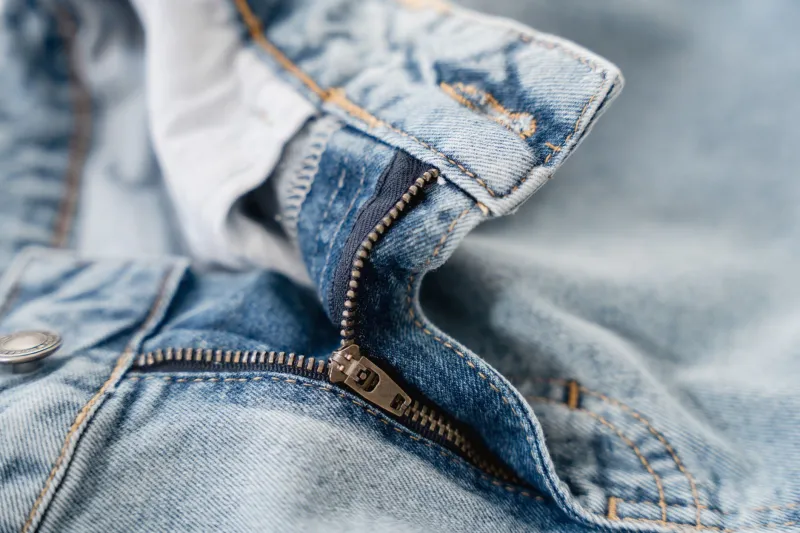
Cheap trim fails first. Polyester-core thread shreds at stress points. Plastic shank buttons crack, and the replacement in your junk drawer never quite matches. Invisible zippers — nylon coil, plastic puller — seize up after a few dozen cycles. Fusible interfacing bubbles and delaminates after a handful of washes, and once it goes, the collar never lies flat again.
So the shirt goes to the tailor for a fifteen-dollar zipper replacement, or the button jar comes out and the match is wrong. Either way, the math tilts toward replacing the whole garment. That’s not a consumer behavior problem. It’s a design decision made years earlier, in a spec sheet nobody outside the factory ever sees.
What trim-first design actually looks like
None of this is exotic. It’s just a different set of priorities at the sample stage.
- Thread that matches the fiber. Cotton or linen thread on a plant-fiber garment keeps the whole thing compostable and recyclable. It also ages the way the cloth does instead of staying rigid while the fabric softens.
- Buttons you can actually move. Corozo, tagua, hardwood, shell, or metal — attached with a proper thread shank and stitched so a replacement can be sewn without unpicking a placket.
- Zippers with a plan. Metal with a replaceable slider, or no zipper at all. Ties, buttons, and plackets are older technology and they fail more gracefully.
- No glue. Sewn-in woven interfacing instead of fusible. It costs a few cents more and buys years of structural life.
- Generous seam allowances. Room to let out, take in, or patch without the seam falling apart.
- A trim spec sheet and a repair kit. Two spare buttons in a paper envelope, plus a card listing the thread weight and zipper model. Cheap to produce, wildly useful to a tailor.
There’s also pressure coming from outside the industry. State-level textile extended producer responsibility bills — California’s among them — are pushing brands to help pay for what they put on the market. When the bill for collection and sorting lands on the brand’s ledger, trims stop looking like a rounding error.
Five questions that expose a garment’s afterlife
You can audit a shirt in about the time it takes to drink a coffee:
- What’s the thread made of?
- Is the zipper metal, and can the slider be replaced?
- Are there spare buttons, and are they sewn on in a way a tailor can replicate?
- Is there fusible interfacing in the collar or placket?
- Does the brand publish care and repair instructions that mention the trim?
A brand that can answer those five has thought about the end of the garment’s life. A brand that can’t has thought about the photo shoot.
The button is the design
The fabric gets the poetry. The trim does the work. A stem-fiber shirt with a plastic button, a glued collar, and polyester thread is a plant-fiber garment designed for a landfill with extra steps.
So the next time you’re holding a hanger in a store, flip the placket. Look at the button, the stitching, the zipper pull. That twelve-cent detail is the difference between a shirt you’ll wear for a decade and a shirt that ends its journey in a reject bin in Sacramento, fully intact and completely useless.